Talbot Is Becoming An Operating Layer For Project Work
2026-05-11
The first Talbot post focused on memory.
That was the right place to start.
If an assistant cannot remember the project properly, it never becomes trustworthy. It just becomes another clever chat window that keeps making the user repeat themselves.
But the new value to pay attention to is bigger than memory alone.
Talbot is starting to move from "remembering the project" to "behaving like part of the project".
That is the more important shift.
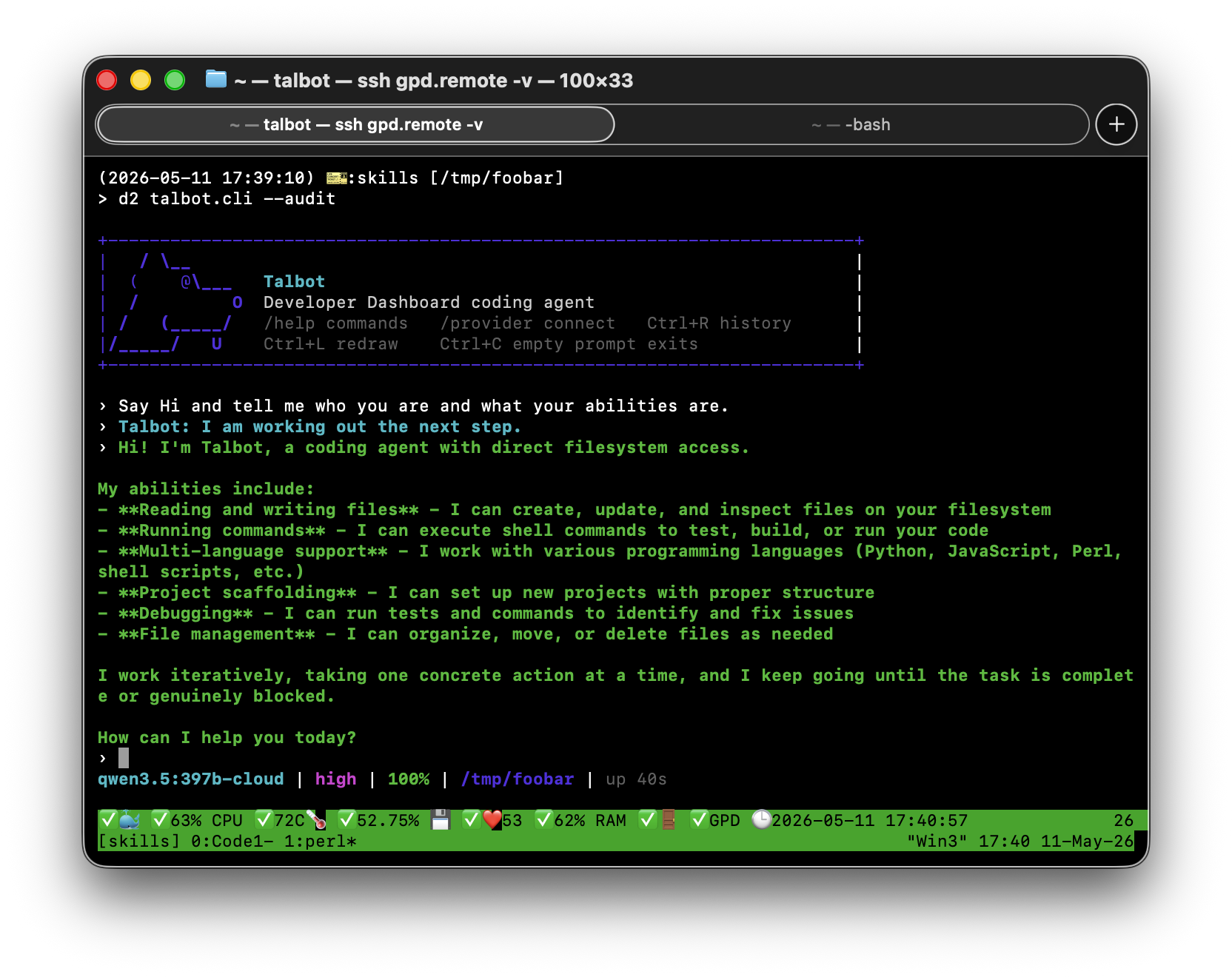
This is where Talbot starts feeling less like a chat surface and more like an operating layer that belongs inside the project workspace.
If you have not read the earlier Talbot post yet, start here first:
- Talbot Is Project Memory, Not Just Another AI Chat
- Introducing Developer Dashboard: A Terminal-First Workspace for Local Developer Operations
- What Changed Since "Layers, Context, Skills, Pages and Runtime"
What Changed Since The Last Post
The last post was about durable local memory, reusable helpers and Developer Dashboard as the foundation.
That is still true.
What is newer now is that Talbot is being shaped around a stronger operating model:
- it should leave an audit trail instead of acting like a black box
- it should follow project workflow instead of jumping straight into random output
- it should keep using the workspace as the source of truth
- it should help turn repeat work into something reusable
- it should show its progress in a way the user can actually inspect
That changes the product story.
Talbot is not only trying to remember what happened.
Talbot is trying to become a more accountable way to get work done inside a project.
The New Value Proposition
Here is the simplest way to say it:
Talbot is becoming an assistant that does not just respond. It can leave behind a trail, a structure and a reusable outcome.
That matters because most assistants are still optimised for one-shot answers.
Talbot is being pushed toward a different standard:
- if it works on a project, the work should be visible
- if it makes a decision, the context should be traceable
- if it repeats a task often, the result should become reusable
- if it starts a bigger piece of work, it should respect the project workflow
That is a better fit for people doing real project work over time rather than isolated prompt sessions.
Why This Matters More Than Model Quality Alone
Most people do not give up on AI tools for technical work because the model is weak.
They give up because the working style is weak.
The assistant might sound smart, but:
- it disappears when the session ends
- it does not leave enough evidence
- it makes too many one-off decisions
- it does not fit naturally into work that has to be reviewed, verified and continued later
Talbot is interesting because it is pushing in the opposite direction.
It is trying to fit the operating reality of project work:
- ongoing context
- visible history
- structured progress
- reusable outcomes
- workflow discipline
That kind of value becomes more obvious after a week or a month, not only in the first ten minutes.
What Feels More Unique Now
The last post established that Talbot was not meant to be just another AI chat.
The newer story is more specific.
Talbot is becoming unusual in four useful ways.
1. Project-accountable, Not Just Prompt-responsive
Talbot is being pushed toward a standard where it cannot simply throw an answer over the wall and disappear.
The work should be inspectable.
That means the user can increasingly ask:
- what happened
- what was used
- what was created
- what context was involved
- what still needs to happen
That is a very different promise from "the model responded quickly".
2. Built To Reuse The Existing Operating Surface
A lot of products try to solve everything by adding one more chat layer.
Talbot is more interesting when it does the opposite.
It can use what Developer Dashboard already gives it:
- helpers
- dashboards
- operational views
- project workflows
- local state
That means Talbot can grow by becoming better at using the environment, not by pretending the environment does not matter.
3. Able To Turn Activity Into Infrastructure
This is one of the most practical things to watch.
If the same kind of work keeps showing up, the better outcome is not "generate it again".
The better outcome is:
- create a helper
- organise it properly
- make it available again later
That turns Talbot from a token burner into a force multiplier.
4. Easier To Inspect As It Gets More Capable
Many systems become less understandable as they become more capable.
Talbot is trying to move the other way.
The more it does, the more important it becomes that the user can inspect:
- audit records
- project context
- knowledge in use
- progress
- outcomes
That transparency is not a side detail.
It is part of the value.
Who Should Pay Closest Attention
This direction matters most for people who are already frustrated with assistants that behave well for one prompt and badly over a full project.
That includes:
- technical solo operators
- maintainers of long-running codebases
- people who work through a terminal all day
- teams that care about traceability
- anyone who wants an assistant to produce durable value, not just temporary output
If someone only wants a quick answer, Talbot may feel like more structure than they need.
If someone wants the assistant to become part of how the project actually runs, this direction becomes much more compelling.
What To Watch Next
The real story is not that Talbot can generate files.
Lots of tools can generate files.
The real story is whether Talbot can reliably do all of this together:
- understand the project context
- stay inside the project rules
- keep the user informed while it works
- leave behind inspectable evidence
- produce outputs that are still useful later
That combination is where the product gets interesting.
The Short Version
The first Talbot story was about memory.
The next Talbot story is about operational trust.
That is the value to pay attention to now.
Talbot is trying to become:
- easier to inspect
- harder to lose context with
- better at following project structure
- more useful over repeated work
- more capable of leaving behind something durable
If that direction holds, Talbot will matter not because it talks well, but because it can become a more dependable working layer inside a real project.